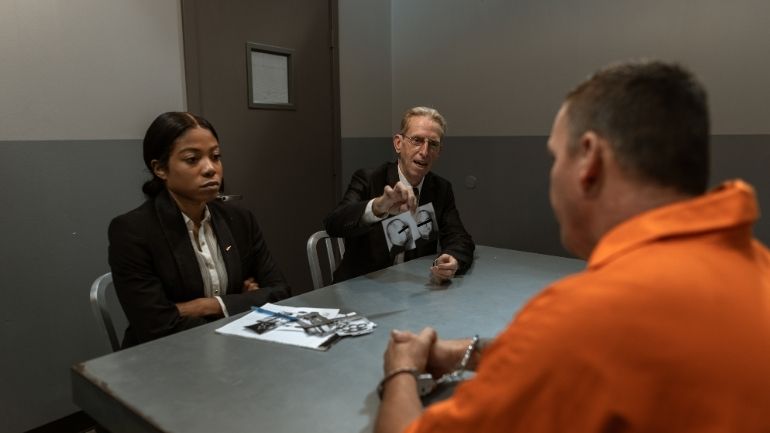
It happens more often than you may realize.
An individual is approached by a law enforcement officer (LEO), who begins by casually asking a few questions. They decide to cooperate and engage. It might be because they haven’t done anything wrong and want to be helpful, because they think saying nothing or walking away will make them look guilty, or because they simply do not realize they have a choice. By the time they realize that the conversation has become something more than a casual discussion, statements have been made that cannot be taken back.
If you have already spoken to police without an attorney present and you are now facing charges or an investigation in Idaho, the situation may be more complicated than you think. The good news? It is rarely hopeless. But you need some help and some good advice.
Sullivan Law Office is a criminal defense firm based in Coeur d'Alene, Idaho. We serve clients throughout North Idaho who have become the subject of a police investigation or who have already been charged or arrested. We help people understand their legal position, their rights, and their options, and we can also help them recover from any adverse consequences of unrepresented police contact. Once we take a client, we act as their advocate, representative, and advisor, providing a protective legal barrier from government criminal enforcement processes that can be confusing, intimidating, and overwhelming.
You Have the Right to Remain Silent, and It Means More Than You Think
The Fifth Amendment to the United States Constitution protects every person from being forced to speak to law enforcement. Specifically, the Amendment provides that:
No person [. . .] shall be compelled in any criminal case to be a witness against himself [...].
Article I, Section 13 of the Idaho Constitution provides the same protection.
These rights are not just technicalities. The Supreme Court has repeatedly enforced the strength and breadth of this provision, spelling out that the right is nearly absolute when it comes to any interaction with law enforcement. It is a foundational protection that exists precisely because the courts have recognized how easily people can be led into saying things that may damage their own interests, even when they are telling the truth and have not committed a crime.
Most people have heard the phrase “Take the Fifth” in the context of being questioned under oath in a courtroom, police interrogation room, or even in a Congressional hearing. But the right applies from the very first moment of any police contact — not just after a formal arrest, not just after Miranda warnings have been read, and not just when you might be in trouble with the law. It applies to every citizen everywhere: on the street, during a traffic stop, at your front door, and in any other setting where law enforcement is asking you questions.
The problem is that most people do not exercise this right when they need it most, because the moment rarely feels like the kind of moment the right was designed for.
Why People Talk and How It Backfires
Understanding why people speak to police without an attorney is not difficult. The reasons are almost always understandable, and almost always work against the person who acts on them. Some examples:
- The belief that cooperation will help. Many people believe that if they explain their side of the story clearly, LEOs will understand and move on. In reality, by the time police are asking you pointed questions about a specific incident, they may have already formed a working theory of what happened. Your explanation is often being evaluated against that theory, not considered with an open mind; telling your side of the story could be enforcing that theory or altering it, but not necessarily in your favor.
- The fear that silence looks guilty. This is one of the most persistent and damaging myths about police encounters. In the context of a criminal incident or case, a defendant's decision to remain silent cannot be used against them as evidence of guilt. The right to remain silent is just that: a right, not an admission. Exercising it is legally neutral, and courts will enforce that principle. Talking, by contrast, creates a record.
- The assumption that only guilty people need lawyers. This assumption gets innocent people into serious trouble with remarkable (and unfortunate) regularity. Innocent people who speak freely to investigators sometimes misremember details, misspeak out of nervousness, provide information that contradicts other evidence without realizing it, or make statements that are technically accurate but sound incriminating when taken out of context. Innocence is not a shield against being charged, and does not protect you from what you say. Innocence is a defense, and one that needs to be developed carefully, with legal counsel, not improvised in a hallway conversation with a detective.
- The sense that the questions seem casual or friendly. Having a positive opinion rather than antagonism toward LEOs is perfectly fine, but your inclination to be polite and supportive does not mean that you should forget context. In a criminal investigation, LEOs conducting investigations are trained in interview and interrogation techniques specifically designed to elicit information from people who might not otherwise provide it. A conversation that feels like a friendly chat may be a structured interrogation. Officers are legally permitted to deceive suspects during questioning, including by misrepresenting the strength of the evidence against them, the statements made by other witnesses, or the consequences of cooperation versus silence.
The bottom line is, if you do feel you have something to say to LEOs, talk to an attorney first. Being silent initially does not mean you have to stay silent, but the better route is to speak to an attorney first about what you know, and have an attorney present with you in any exchange with the police.
What Miranda Warnings Actually Mean, and What They Do Not
Most people have seen enough police shows to know that police are required to read Miranda warnings to people they arrest. The Miranda warning is so-called because in a case called Miranda v. Arizona, the Supreme Court held that police must inform arrestees of their rights. The warning has variations, but the basic statement usually encompasses the following:
Anything you say can and will be used against you in a court of law. You have the right to an attorney. If you cannot afford an attorney, one will be provided for you before any questioning if you wish. Do you understand the rights I have just read to you? With these rights in mind, do you wish to speak to me?
The common rule is that, if an LEO was required to give you the Miranda warning and failed to do so and you talked to them or answered their questions, they cannot use what you said against you. But what most people don’t understand is that giving a Miranda warning is not required every time an LEO talks to you, and courts narrowly interpret the circumstances that trigger that requirement.
Miranda warnings are required only when a person is taken into custody and subject to interrogation. Custody, in legal terms, does not simply mean being at a police station or having handcuffs on. Courts have generally applied a test based on whether a reasonable person in the same circumstances would have felt free to leave. Many interactions that feel coercive and unavoidable to the person being questioned do not meet the legal definition of custody, which means Miranda warnings are not required, and statements made during those encounters are fully admissible even without any Miranda warning being given.
This is one of the most significant gaps between what people believe about their rights and what the law actually provides. A person who speaks freely to an officer during a traffic stop, during a knock-and-talk at their home, or during a so-called voluntary interview at the police station may never trigger the requirement that an LEO issue a Miranda warning, which means that every word said may be used by the prosecution.
How Statements Get Used Against Defendants
People are often surprised how much what you say to an LEO can set in motion. Once a statement is made to law enforcement, it becomes part of the investigative record. It may be recorded on a body camera, on a dash camera, or in a written report prepared by the officer after the fact. It may be summarized in a probable cause affidavit used to obtain a search warrant or support a charging decision. It may be introduced at trial as an admission or as a prior inconsistent statement if the defendant's account later changes in any detail.
Statements do not have to be confessions to be damaging. Partial admissions, inconsistencies between what a defendant told police and what other evidence shows, statements that place a person at a location they later deny being at, or explanations that seem implausible in light of the physical evidence — all of these can be used to undermine a defense, place the credibility of a witness or defendant into doubt, and bolster the prosecution's case. Even a statement that is entirely truthful can be harmful if it provides information the prosecution did not previously have, fills a gap in their evidence, or contradicts the testimony of others.
A statement made by a defendant that is not barred by the Miranda rule is freely admissible against them at trial; there is no requirement that the statement be obtained in any particular way or that the defendant understood its significance at the time.
What Can You Do If You Have Already Talked?
This is a situation that brings many clients to Sullivan Law Office. They spoke to police — sometimes briefly, sometimes at length — and now they are worried about what they said and what it means for their case. The first and most important thing to understand is that speaking to police without an attorney does not mean your case is over. It means your attorney has additional work to do.
An experienced criminal defense attorney will obtain all recordings, reports, and documentation related to your prior statements and analyze them carefully. The goal is to understand exactly what was said, why you said it, whether there is any important context to what you said, how it fits with the rest of the evidence, whether any of it is subject to challenge on constitutional or evidentiary grounds, and how to build a defense strategy that accounts for what is in the record.
In some cases, statements may be suppressed, but only if they were obtained in violation of a defendant’s rights. For example, if a statement was obtained in violation of Miranda, the product of an unlawful detention, or coerced in a legally cognizable way, a motion to suppress may be successful. However, getting it suppressed requires that the constitutional standard was not met.
In other cases, suppression is not available, but context and explanation can still meaningfully affect how a statement is understood by a jury. A defense attorney who understands the full circumstances of a client's police contact can work to ensure that the jury hears the complete picture, not just the portion the prosecution finds useful.
What Can You Do Now?
If you have already spoken to police and you are facing charges or believe an investigation is ongoing, the single most important thing you can do right now is stop talking — to law enforcement, to anyone connected to the case, to anyone else who might later be called as a witness, and even to family members and friends. The damage from past statements may be manageable, but any additional statements made without legal guidance rarely help — and frequently, make things worse.
The second most important thing you can do is contact a criminal defense attorney as soon as possible. The earlier an attorney is involved, the more effectively they can assess the damage, develop a defense strategy that accounts for what is already in the record, and protect you from making the situation any worse.
Sullivan Law Office represents clients facing criminal charges throughout North Idaho. If you have spoken to police without an attorney and you are concerned about what it means for your case, contact us today. It is not too late to get the right help — but the sooner you do, the better position you will be in.
This article is for general informational purposes only and should not be construed as legal advice.